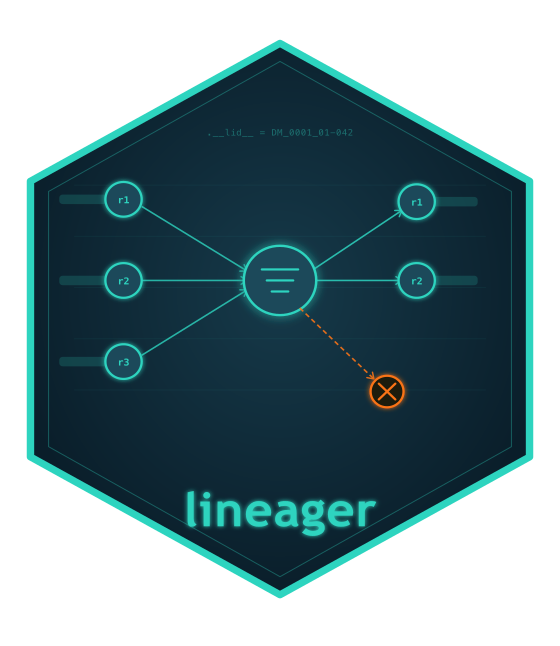
Works exactly like dplyr::filter() but requires a reason for every
exclusion. Rows that do not meet the filter conditions are captured in the
session exclusion registry with their USUBJID (if present), lineage ID,
and the documented reason.
Arguments
- data
An
lg_dffromlg_tag().- ...
Filter conditions, passed to
dplyr::filter().- reason
Character. Mandatory. Why these rows are being excluded. E.g.
"Not randomised (RANDFL != 'Y')".- population
Character or
NULL. Which population flag this exclusion relates to (e.g."SAFFL"). Used to group the exclusion listing.- reason_code
Character or
NULL. Short controlled-vocabulary code for this exclusion (e.g."NOT_RANDOMISED"). Useful for programmatic querying of the exclusion registry.
Value
An lg_df containing only the rows that passed the filter.
Excluded rows are recorded in the session store.
Details
reason has no default. Undocumented exclusions are a compliance failure :
this is enforced at the R level, not by convention.
Examples
lg_start()
#> lineager: session started
adsl <- lg_tag(
  data.frame(
    USUBJID = c("01", "02", "03"),
    RANDFL = c("Y", "N", "Y"),
    SAFFL = c("Y", "N", "Y")
  ),
  dataset_id = "ADSL"
)
#> lineager: tagged 'ADSL' — 3 rows, 3 cols

adsl_rand <- lg_filter(
  adsl,
  RANDFL == "Y",
  reason = "Not randomised (RANDFL != 'Y')",
  reason_code = "NOT_RANDOMISED",
  population = "RANDFL"
)
#> lineager: [ADSL] filter 'Not randomised (RANDFL != 'Y')' — 3 in, 2 out, 1 excluded